City Tech library has a large comics and graphic novels collection, over 400 print books, which you can browse online before coming to the library. Our graphic novels are located under the central staircase on the 4th floor of the library (the floor where users enter). Graphic novels can be borrowed for the same 8 week period like other circulating books.
Is there a book you’d like us to buy? Just email me at monica.berger11@citytech.cuny.edu. Please include as much information as possible but feel free to send a link to Amazon or a publisher’s website if that’s easier for you. Note that we do not buy individual comic books that do not have a spine.
The Ursula C. Schwerin Library was one of 17 libraries nationwide awarded an American Libraries Association (ALA) Building Library Capacity Grant. The $10,000 grant is intended to “improve technology access “broaden technology access, develop collections, provide digital instruction, increase staffing, and expand outreach, or maintaining or amplifying other existing service strategies or adding new ones.” Prof. and Interim Chief Librarian Anne Leonard, Prof. Monica Berger, and Prof. Junior Tidal co-wrote the grant proposal.
The grant will provide the City Tech community access to equipment that they can borrow. The focus is primarily on audio technology, including podcasting kits, a podcasting booth, for students and faculty to create their own podcasts, portable turntables to listen to the library’s vinyl LP collection, as well as funding to add more albums to the collection. The library is planning to collect student input for album recommendations, as to reflect the broad diversity of the City Tech community.
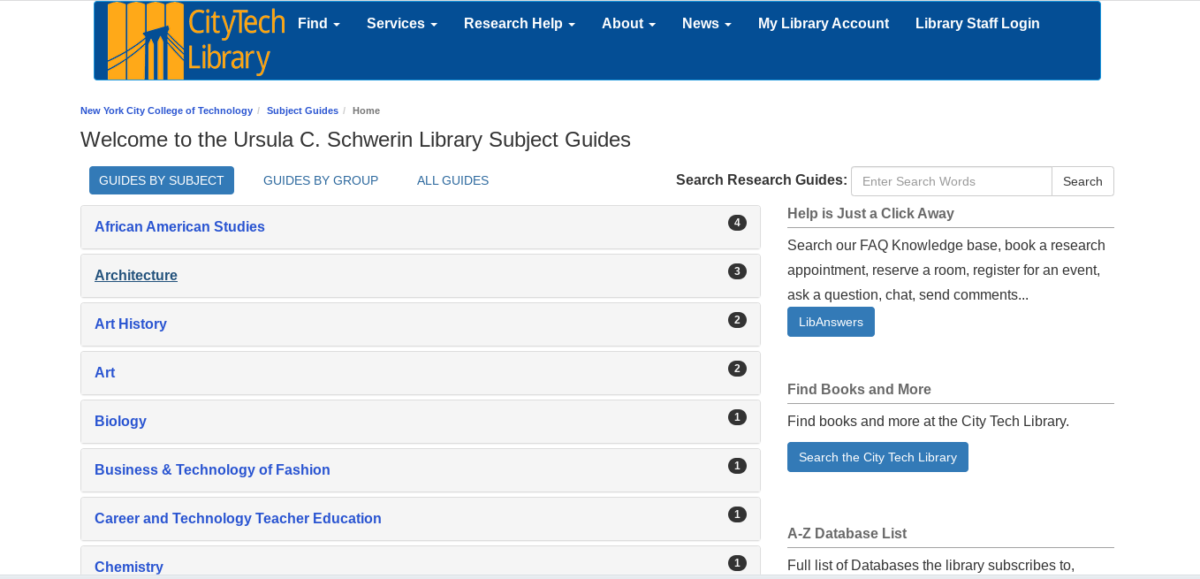
The City Tech Library has revamped their Libguide collection making it more accessible for everyone.
The Ursula C. Schwerin Library is committed to developing equitable online spaces and included an accessibility focus within their June initiatives. According to the American College Health Association, 12% of undergraduate students reported having a disability, and recent data found that almost 13% of the U.S. population has a disability. While improving accessibility directly benefits those with disabilities, web accessibility benefits all users by removing restrictions on who can access information. This inclusive approach broadens access, increases participation, and promotes usability.
A library’s Libguide collection would ideally follow WCAG guidelines and offer resources that are user friendly, accessible, well designed, and findable. The City Tech Libguide Collection includes over fifty research guides on relevant subjects.
Adjunct librarians working in the library tackled this initiative through an assessment process that focused on accessibility aspects like alt text and screen reader capability. To conduct an audit of the Libguides, code inspection tools were utilized, rendering valuable information on accessibility errors. Two separate inspection tools found over 200 errors across ten guides. These errors ranged from low contrast, and missing corresponding labels, to dozens of images that were missing alt text.
Our audit-based suggestions included solutions to improve usability and ensure future accessibility errors do not occur. Improved guides were designed to mitigate and address accessibility issues pertaining to readability and inconsistency with navigation. The following Libguides have been coded and redesigned for inclusivity and accessibility:
Our Libguide collection offers an extensive catalog covering various topics and subject matters. Libguides are typically developed by academic librarians to help staff and students navigate resources and find information. Academic libraries have a responsibility to withhold accessibility standards for everyone’s access. This process is an ongoing endeavor that requires libraries to proactively address current content and responsively create new and accessible content. If you’re interested in seeing more Libguides- be sure to check out the full collection here.
The City Tech Library has a new display curated by College Assistants working in the library this summer. Films on the display are available for check out, and is located at the main entrance of the Ursula C. Schwerin Library.
There are a variety of films in the display, from major theatrical releases to independent documentaries, and everything in between.
The collection was developed under the guidance of Profs. Nora Almeida, Jen Hoyer, and Junior Tidal.
May is Asian American Pacific Islander (AAPI) Heritage Month. Originally designated as a week by President Carter in 1978 and observed the following year, President George H. W. Bush designated it as a month in 1992.
The Ursula C. Schwerin Library has a book display to celebrate the month long observance. You can view the display in the coming weeks which features a variety of books from the library’s collection, including non-fiction, fiction, cookbooks, and more. Until then, the City Tech community may view the available books through this digital collection, which was curated by Prof. Junior Tidal and implemented by Jen Hoyer.
May is AAPI month. City Tech students, staff, and faculty can celebrate with these streaming film selections:
Blue Bayou As a Korean-American man raised in the Louisiana bayou works hard to make a life for his family, he must confront the ghosts of his past as he discovers that he could be deported from the only country he has ever called home.
Alfred “Boogie” Chin is a talented high school basketball player from Queens, New York, who dreams of playing in the NBA. His parents, however, have a different plan for him: they want him to focus on getting a scholarship to an elite college instead. While already burdened with high expectations, he finds himself struggling more as he tries to navigate high school, a new girlfriend, and fierce on-court rivals.
“Crazy Rich Asians” follows native New Yorker Rachel Chu (Constance Wu) as she accompanies her longtime boyfriend, Nick Young (Henry Golding), to his best friend’s wedding in Singapore. Excited about visiting Asia for the first time but nervous about meeting Nick’s family, Rachel is unprepared to learn that Nick has neglected to mention a few key details about his life. It turns out that he is not only the scion of one of the country’s wealthiest families but also one of its most sought-after bachelors. Being on Nick’s arm puts a target on Rachel’s back, with jealous socialites and, worse, Nick’s own disapproving mother (Michelle Yeoh) taking aim. And it soon becomes clear that while money can’t buy love, it can definitely complicate things.
Grappling with the onset of middle age, a Chinese immigrant discovers that she can traverse across time and space. Teaming up with her alternate lives, the unlikely allies realize that they alone possess the power to protect the world from calamity, plunging them into the midst of an outlandish quest.
Following the aftermath of the March 2021 mass shootings at three spas in Atlanta, this film chronicles how the Asian American community came together to fight back against hate. Offering a conversation about race, class and gender, the film takes a deep dive into this critical moment of racial reckoning, exploring the struggles, triumphs and achievements of AAPI communities.
This series traces the story of Asian Americans, spanning 150 years of immigration, racial politics, and cultural innovation. It is a timely look at the role that Asian Americans have played in defining who we are as a nation. During the Cold War years, Asian Americans are simultaneously heralded as a Model Minority, and suspected as the perpetual foreigner. It is also a time of ambition, as Asian Americans aspire for the first time to national political office.
The library offers laptop loans to all enrolled City Tech students! Stop by the library’s Multimedia Resource Center. It is located on the 4th floor, to the left of the library’s entrance.
Laptops can be borrowed for 1 week from the library. You can check one out with your City Tech ID.
For questions or concerns, contact Prof. Junior Tidal, Web Services & Multimedia Librarian.
There are numerous new films for the spring 2023 semester through the library’s electronic resource, Swank, including recent theatrical releases, Oscar nominees (like Everywhere, Everything, All At Once), and timely documentaries. City Tech students and faculty can access Swank on or off-campus using your CUNYfirst credentials.
Below are some highlights. For more information about these films, Swank, or other streaming films available to the City Tech community, reach out to Prof. Junior Tidal.
Many New Yorkers from different cultural backgrounds will soon celebrate Christmas Eve and Christmas with big, multi-course feasts. One of the most elaborate is The Feast of the Seven Fishes, an Italian-American Christmas Eve celebration. It may include seven or more specific fish dishes, such as whiting in lemon, clams in spaghetti, or baccalà (dried, salted cod). If you ever want to try to create your own feast, there are several pesci recipes in Canal House Cooking: Pronto! for you to try.
Filipinos celebrate Christmas from December 16 until the first Sunday of January and the Feast of the Three Kings. After Christmas Eve midnight mass, preparation begins for Noche Buena, when family, friends, and neighbors drop by for an open house celebration. Food is often served in buffet style. Among the typical foods prepared are lechon (roasted pig), queso de bola, ham, spaghetti, and fruit salad.Filipino Family Cookbook : A Treasury of Heirloom Recipes and Heartfelt Stories is a great resource if you’d like to learn more.
For many Latinos in the United States, the holiday season is synonymous with tamales. Mexican Americans often opt for corn-husk-wrapped tamales, while those from Central America typically wrap theirs in banana leaves. And while most Mexican and Central American tamales contain corn-based masa, Puerto Rican pasteles don’t use any, instead using a combination of ground yautía (yuca) and green plátanos (plantains).Tamales, Comadres, and the Meaning of Civilization is filled with family recipes and stories. It also celebrates tamaladas, large family gatherings to prepare the Christmas tamales.