Ieoh Ming Pei American-Chinese, world-famous architectural designer. He was born on April 26, 1917, in Guangzhou, China. Ieoh Ming Pei spent almost all of his childhood in Guangzhou and Hong Kong, as well as the Lion Forest Garden (Suzhou Classical Garden). After his mother died, Pei’s family moved to Shanghai, and then Ieoh Ming Pei decided to move to the United States. He studied architecture at the University of Pennsylvania, but in order to the pursuit of better structural engineering knowledge, he transfers to the Massachusetts Institute of Technology in Boston, Massachusetts. During the period of study at MIT, Dean Willian Emerson persuaded Pei to study architecture again. In 1940, Pei graduated from the Department of Architecture at MIT and won the American Institute of Architects Gold Medal. After the outbreak of World War II, he worked at the NDRC until 1945. In 1942, Pei married Eileen loo who studies at Harvard’s Graduate School of Landscape Architecture. After the wedding, the Pei couple to Cambridge Massachusetts. After the introduction of his wife, Pei enrolled in the Harvard Graduate School of Design in the summer of 1942. Between 1943 and 1945, Pei and Walter Gropius and two other students E. H. Duhart and Frederick Roth designed several low-cost modern houses and gained popularity for the first time in Arts and Architecture magazine. In 1948, Pei ’s career as a Harvard professor ended, and he moved from the Cambridge town of Boston to New York. At the same time, he was hired to direct the architectural division of Webb and Knapp. In 1960, Pei left Webb and Knapp and founded his own company. In the following days, Pei left many famous buildings, such as the Louvre Pyramid, Suzhou Museum, Museum of Islamic Art, Doha, Rock & Roll Hall of Fame, Bank of China Tower.
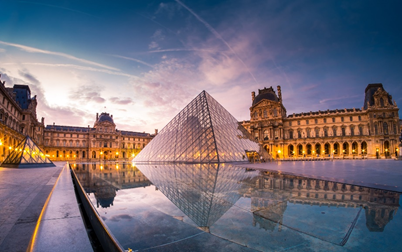
In the early 1980s, French President Mitterrand decided to rebuild the world-famous art treasure, Louvre. Later, Pei received the most important commission in his career that rebuilds the Louvre, which also became one of the company’s secrets. Pei secretly went to Paris to study the Louvre, for which he also specifically studied the historical landscape of French designer André Lenot. After being inspired by French designer André Lento, Pei believes that this historical design was built for living people. Therefore, Pei had the idea of a glass pyramid. He designed the pyramid using ordinary geometric figures and glass on the material to reflect the beauty of the sky. Also, it provides good lighting for underground facilities. However, this design caused an uproar in France, which is believed to the glass pyramid to destroy this 800-year-old ancient architectural style. In the Pei documentary, he said that 90% of people opposed his design, and he was ignored and opposed by people. Therefore, he built a full-scale model in front of the Louvre and invited 60,000 Parisians to visit and vote. As a result, most people changed their original ideas and agreed with this glass pyramid design. Therefore, he built a full-scale model in front of the Louvre and invited 60,000 Parisians to visit and vote. As a result, most people changed their original ideas and agreed with this glass pyramid design.

Although Pei was born in Guangzhou, his ancestral home in Suzhou, Jiangsu. During his childhood, he also spent some time in the Lion Forest (Suzhou Classical Garden). Suzhou, as Pei’s hometown, 85-year-old Pei readily accepted the commission. The design of the museum combines modern and traditional Suzhou architecture to put the museum between the courtyards which harmonizes the building with the surrounding environment. In the design of the Suzhou Museum, Pei Yuming cleverly used geometric structure, grey lines, and white exterior walls to show the combination of Chinese antique and modern style. The layout of the Suzhou Museum is characterized by a rectangular layout that surrounds the central water channel, which is composed of a central pavilion and organized by a central axis of symmetry. This layout is largely similar to Chinese garden architecture.
As a modernist architectural designer, Pei has more works than theory which shows the art of architecture through practice. He is also good at combining the ancient traditional architectural art and the latest modern technology in one furnace, thus creating his own unique style. Pei Yuming himself said: It turns out that the persistent pursuit of architectural art is an important aspect of his career success.
Work cited
Architectmagazine.com, www.architectmagazine.com/awards/aia-honor-awards/louvre-pyramid-the-folly-that-became-a-triumph_o.
Bear, Rob. “Mapping I.M. Pei’s Major Works.” Curbed, Curbed, 17 May 2019, www.curbed.com/maps/im-pei-buildings-louvre-completed-works.
Heidi. “I. M. Pei’s East Building: Solving Problems of Form and Function. Teacher’s Guide. School Arts: Looking/Learning.” ERIC, National Gallery of Art, 4th and Constitution Avenue, NW, Washington, DC 20565. For Full Text: Http://Www.nga.gov/Education/Teachres.htm., 31 Mar. 1999, eric.ed.gov/?id=ED450024.
Howarth, Dan. “10 Of IM Pei’s Most Significant Buildings.” Dezeen, 21 May 2019, www.dezeen.com/2017/04/26/architect-im-pei-100-birthday-10-most-significant-buildings/.
“I. M. Pei Biography.” Encyclopedia of World Biography, www.notablebiographies.com/Ni-Pe/Pei-I-M.html.
“Suzhou Museum: I. M. Pei’s Contemporary Re-Imagining of a Remembered Past.” Nonagon Style, 5 Sept. 2019, nonagon.style/suzhou-museum-im-pei-contemporary/.
“贝聿铭.” 到百科首页, baike.baidu.com/item/贝聿铭/84461?fr=aladdin.





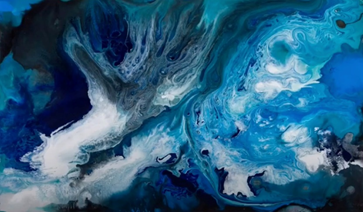


 In the first concept, there are two colors in a rectangle. The black color presented Maya Angelou’s awful experiences. The white color presented the light and beauty in her life. And then, I used different font types. There are obvious differences between black and white. “I Rise” is thicker than “And Still” which means strong and powerful. Also, for the font types on the left side, I drew the black line inside of each letter to present the darkness and difficulties that she has experienced in her life.
 For the second visual quote project, I changed the layout of the first concept from landscape to portrait because it presents a better visual effect than the landscape layout. I also applied gradient on the black and white background to visually present the different stages of Maya’s life (from “dark” to “light”). After receiving some feedback, I changed the font type of the quote to San Serif and increased the difference in the font-weight between “and still” and “I rise”, which vividly presents that Maya’s strong will paid off and eventually achieved success. Lastly, I added some “scratches” to “and still” to present darkness and difficulties that she experienced early in her life.
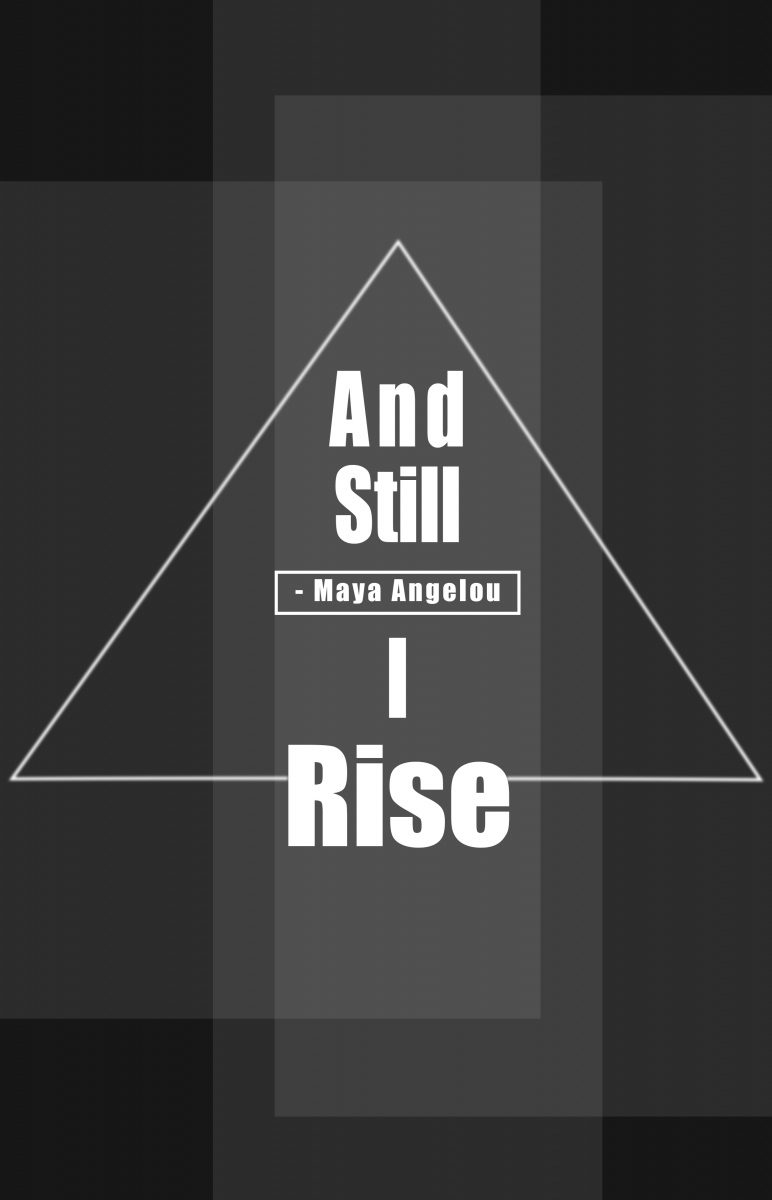 In the second concept, I used a triangle to present the heart of Maya Angelou because it is the strongest shape. I put the “Rise” on the baseline of the triangle wanting to show “Rise” supporting the whole triangle. In the center of the triangle, I put the author in a rectangle which presents the most powerful center. Also, the black and white present the dark and light.
 For the second concept, I enhanced the visual effect by changing its background color from white to red. The red color presents the power and energy in Maya’s life. Also, I took a classmate’s suggestion and moved the Maya Angelou attribution below “Rise.”
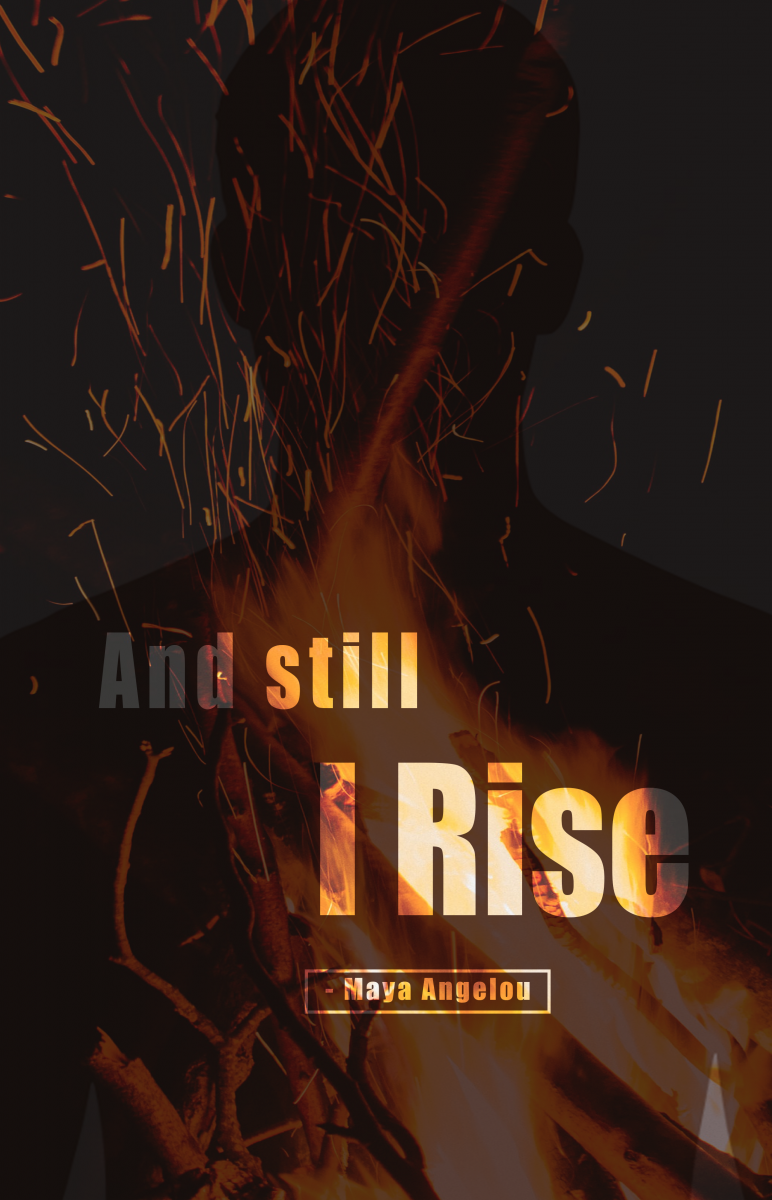 In the third concept, I used a picture of fire for the background and set it as a multiply to create an effect in which the words and fire are intertwined. I also placed the human shadow in the fire with a multiply effect, hoping to create an effect of a reborn.
 For the third concept, I took suggestions from the professor and classmates. I corrected a copyright and formatting issue by placing the photo credit, as well as removing the border and dash from the Maya Angelou attribution.
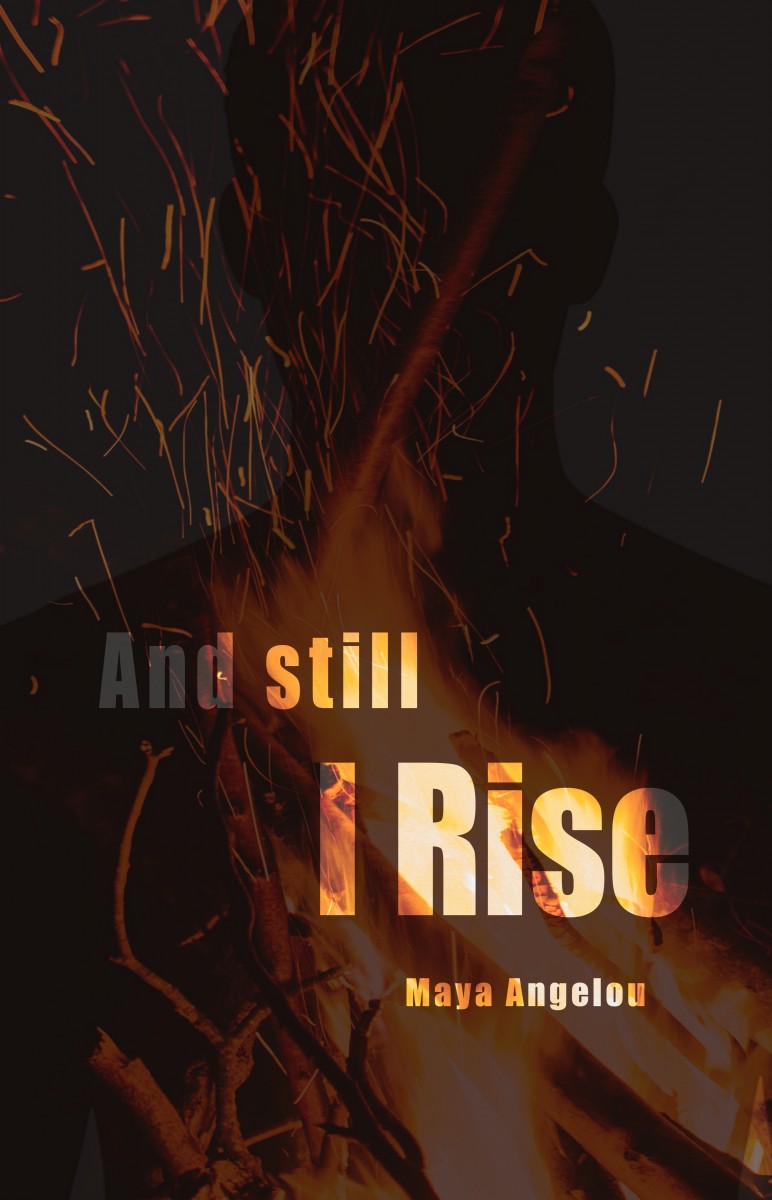 Photo Copy From Pinterst AMOLED Fire Wallpaper